Piaggio Vespa 1961 for DAZ Studio
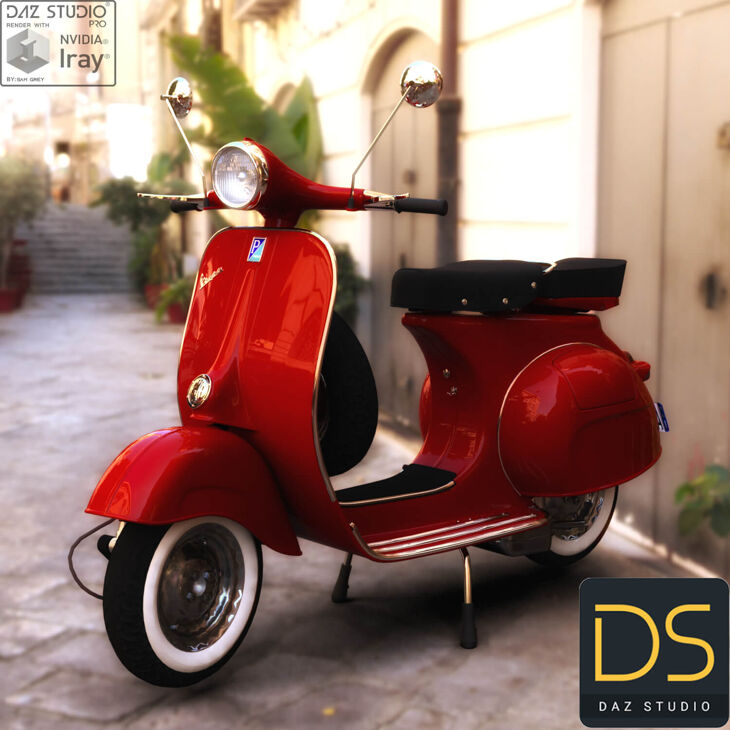
nerdadantes released Piaggio Vespa 1961 for DAZ Studio on RenderHub. The full archive is available from the mirrors listed below.
Vespa (Italian pronunciation: [vspa]) is an Italian brand of scooters and mopeds manufactured by Piaggio. The name means wasp in Italian. The Vespa has evolved from a single model motor scooter manufactured in 1946 by Piaggio & Co. S.p.A. of Pontedera, Italy to a full line of scooters and one of seven companies today owned by Piaggio.
From their inception, Vespa scooters have been known for their painted, pressed steel unibody which combines, in a unified structural unit, a complete cowling for the engine (enclosing the engine mechanism and concealing dirt or grease),a flat floorboard and a prominent front fairing.
After World War II, in light of its agreement to cease war activities with the Allies, Italy had its aircraft industry severely restricted in both capability and capacity.
Piaggio emerged from the conflict with its Pontedera bomber plane plant demolished by bombing. Italy’s crippled economy, and the disastrous state of its roads, were not immediately conducive to the redevelopment of the automobile market. Enrico Piaggio, the son of Piaggio’s founder Rinaldo Piaggio, decided to leave the aeronautical field in order to address Italy’s urgent need for a modern and affordable mode of transportation for the masses.
In 2024, Piaggio celebrated 140 years with limited edition of ‘Vespa 140th of Piaggio,’ with only 140 units available from April 18th to 21, 2024.
In 1944, Piaggio engineers Renzo Spolti and Vittorio Casini designed a motorcycle with bodywork fully enclosing the drivetrain and forming a tall splash guard at the front. In addition to the bodywork, the design included handlebar-mounted controls, forced air cooling, wheels of small diameter, and a tall central section that had to be straddled. Officially known as the MP5 (“Moto Piaggio no. 5”), the prototype was nicknamed “Paperino” (meaning “Donald Duck” in Italian).Piaggio was displeased with the MP5, especially the tall central section. He contracted aeronautical engineer Corradino D’Ascanio, to redesign the scooter.D’Ascanio, who had earlier been consulted by Ferdinando Innocenti about scooter design and manufacture, made it immediately known that he hated motorcycles, believing them to be bulky, dirty, and unreliable.
D’Ascanio’s MP6 prototype had its engine mounted beside the rear wheel. The wheel was driven directly from the transmission, eliminating the drive chain and the oil and dirt associated with it. The prototype had a unit spar frame with stress-bearing steel outer panels.These changes allowed the MP6 to have a step-through design instead of a tall center section like that of the MP5 Paperino. The MP6 design also included a single-sided front suspension, interchangeable front and rear wheels mounted on stub axles, and a spare wheel. Other features of the MP6 were similar to those on the Paperino, including the handlebar-mounted controls and the enclosed bodywork with the tall front splash guard.
Upon seeing the MP6 for the first time, Enrico Piaggio exclaimed: “Sembra una vespa!” (“It looks like a wasp!”) Piaggio effectively named his new scooter on the spot.Vespa is both Latin and Italian for wasp—derived from the vehicle’s body shape: the thicker rear part connected to the front part by a narrow waist, and the steering rod resembled antennae.
On 23 April 1946, at 12 o’clock in the central office for inventions, models and makes of the Ministry of Industry and Commerce in Florence, Piaggio e C. S.p.A. took out a patent for a “motorcycle of a rational complexity of organs and elements combined with a frame with mudguards and a casing covering the whole mechanical part”.
The basic patented design allowed a series of features to be deployed on the spar-frame that would later allow quick development of new models. The original Vespa featured a rear pillion seat for a passenger, or optionally a storage compartment. The original front protection “shield” was a flat piece of aero metal; later, this developed into a twin skin to allow additional storage
Specifications
- Source: RenderHub
- File format: Daz Studio DUF
- Software / install: Daz Studio
- SKU: 207922
- Artist: nerdadantes
It is available through 7 mirrors. Registration is free and takes a moment.